
Green Bean
Phaseolus vulgaris
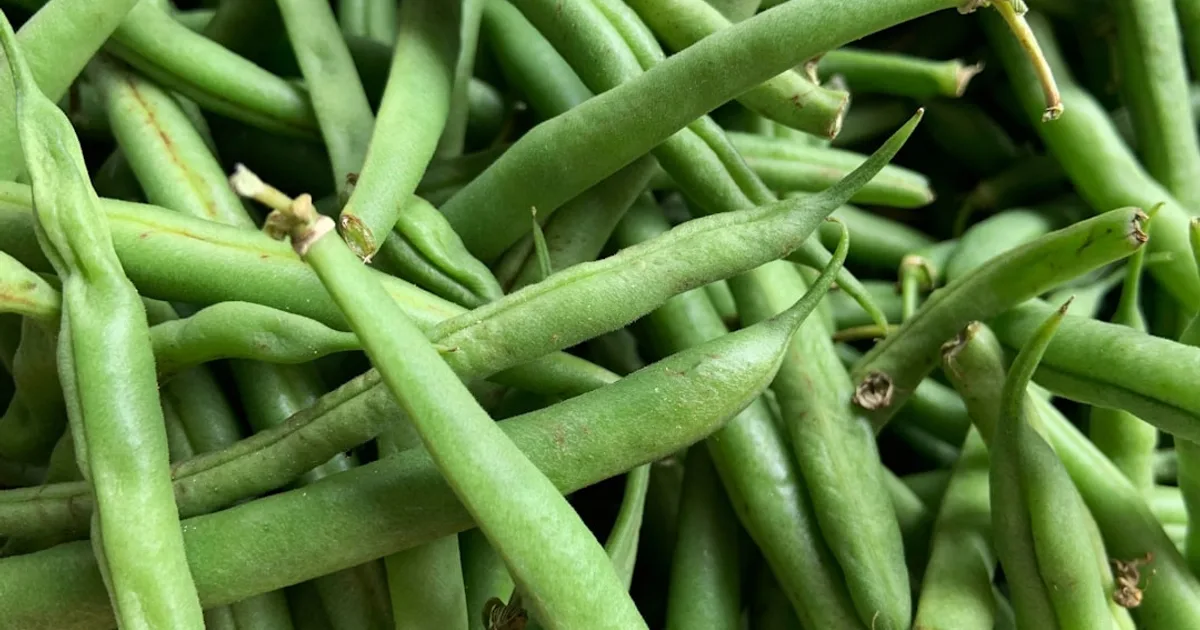
Green bean (Phaseolus vulgaris) is one of those crops where the case for growing your own doesn’t rest on complex economics. It rests on eating a bean you picked twenty minutes ago versus eating a bean that was harvested three weeks ago, refrigerated, shipped, and shelved. The difference is real enough that people who have grown beans for years stop buying them fresh at the store almost entirely - not because store beans are terrible, but because homegrown beans at peak flavor make them taste that way by comparison.
The numbers work too, which helps.
The ROI Case
Seed cost: $2–$4 for enough to plant a 4×8 bed (approximately 30 bush bean plants at 2-inch spacing). Bush beans yield 0.5–1 lb per plant in decent conditions (Cornell Cooperative Extension, Vegetable Varieties for the Home Garden; OSU Extension, Snap Bean Production, HYG-1201). Pole beans yield more per plant - 1.5–3 lb over a full season - but spread that yield across 6–8 weeks rather than concentrating it.
The 4×8 bed calculation: 30 bush bean plants × 0.75 lb average yield = 22.5 lb. At $2/lb retail (USDA AMS fresh green bean average), that’s $45 gross value. Seed cost: $3. Net harvest value from one 4×8 bed in a 55-day window: $42. That’s not a 10:1 return on a seed investment - but green beans fill the bed once, are ready in under two months, and leave room for a fall crop of something else.
Retail: fresh green beans run $1.50–$2.50/lb (USDA AMS). Frozen store green beans average $1.00–$1.50/lb equivalent. The quality premium of homegrown beats either comparison point, but those are the numbers for calculating replacement value.
The honest position: green beans aren’t a high-return crop in terms of $/lb relative to herbs or cherry tomatoes. What tilts the calculation is the flavor premium that store beans can’t match. The commercial bean is harvested before full development for shipping durability, held in cold storage, and losing sugars to starch the whole time. The bean you pick at pencil-thin and eat within hours isn’t a better version of that bean. It’s a different food.
Frozen beans from the store don’t close the gap either. Commercially frozen beans are processed quickly after harvest, so the quality is decent - but home-frozen beans from your own garden, handled the same day, blanched properly, are noticeably better. More on that below.
Bush vs. Pole: A Real Decision
This isn’t just a space question. Bush beans and pole beans produce differently, mature differently, and suit different end uses.
| Characteristic | Bush Beans | Pole Beans |
|---|---|---|
| Days to maturity | 50-60 days | 65-80 days |
| Trellis needed | No | Yes - 6-foot minimum |
| Harvest window | 7-10 day peak window | 6-8 weeks continuous |
| Yield per plant, season | 0.5–1 lb | 1.5–3 lb |
| Best use | Canning, batch freezing | Fresh eating, steady supply |
| Representative varieties | Blue Lake 274, Provider | Kentucky Wonder, Rattlesnake |
Bush beans grow 18 to 24 inches tall and set pods over a concentrated two to three week window. That’s not a flaw - it’s the point if you’re planning to can or freeze a batch. You get a large quantity at once, you process it, and you move on. The concentrated harvest is what makes succession planting work as a preservation strategy.
Pole beans climb 6 to 8 feet and produce continuously for most of the season as long as you harvest regularly. Leave mature pods on the plant and production slows or stops - the plant shifts energy to seed maturation. Pick every two to three days and a single planting will keep producing from mid-July into September in most of the country. Per square foot of garden ground, pole beans yield more over a full season than bush types. But the yield is spread across weeks, which makes batch canning complicated.
Choose bush beans if you’re planning to put up a large quantity for winter. Choose pole beans if your goal is a long steady supply of fresh beans through the season and you’re willing to build or install a trellis.
Varieties Worth Knowing
Not all green beans are the same crop. Flavor, pod type, disease resistance, and intended use vary more than most people expect from such a common vegetable.
| Variety | Type | Days | Pod | Notes |
|---|---|---|---|---|
| Blue Lake 274 | Bush | 55 | Round, stringless | The canning standard. Consistent pod set, holds quality through processing. |
| Provider | Bush | 50 | Round, stringless | Best disease resistance of common bush types. Good choice if you’ve had mosaic virus problems. Reliable in cold, wet springs. |
| Kentucky Wonder | Pole | 65 | Flat, slightly fibrous | Classic heirloom. Strong flavor, productive. Pods get tough if you let them go too long. |
| Rattlesnake | Pole | 65 | Round, purple-streaked | Outstanding flavor, heat and drought tolerant. Good choice for hot climates or late-season planting. Streaks disappear when cooked. |
| Dragon Tongue | Bush | 55 | Yellow with purple streaks | No-string pods with a mild, slightly buttery flavor. Eaten raw or lightly sautéed. Not ideal for canning - doesn’t hold color or texture through processing. |
Dragon Tongue gets its own mention because it’s good in a way that surprises people expecting a novelty. It’s one of the best raw-eating beans, and if you grow it alongside a standard green bean you’ll use the green beans for canning and the Dragon Tongue for salads and snacking. The two-variety approach covers both ends of the use case.
Succession Planting for Canning Quantity
If you’re growing beans to can, the math matters. You need to know how many rows to plant and whether to plant all at once or in succession.
Water-bath canned green beans are not a safe option - beans are a low-acid vegetable and require pressure canning to reach the temperatures necessary to destroy Clostridium botulinum spores (National Center for Home Food Preservation, USDA, 2015). A pressure canner is required. A standard quart jar of canned green beans holds approximately 1.5 lb of fresh-trimmed beans (NCHFP, Selecting, Preparing and Canning Vegetables: Beans, Snap and Italian, 2023). To put up 12 quarts, you need about 18 lb at minimum - accounting for trimming loss and the fact that you’ll snack through some of it during processing, 25–30 lb of fresh beans is a realistic planning target.
At 5 to 8 lb per 10-foot row, 30 to 35 lb means 4 to 5 ten-foot rows.
Here’s the succession question: do you plant all 4 to 5 rows at the same time, or do you stagger them?
All at once: You’ll harvest everything in the same two to three week window, which means you’ll be canning a big batch all at once. That’s fine if you have the equipment and the time blocked out. The advantage is simplicity. The disadvantage is that you’re running a canning operation during your peak garden season when other crops also need attention.
Succession: Plant 2 rows, then 2 more rows two weeks later, then a third planting two weeks after that if you want to extend further. With 2 rows per planting that’s roughly 10 to 16 lb per harvest wave. You’re doing smaller canning sessions - two or three batches of 6 to 8 quarts rather than one batch of 12 to 14. Most people find this easier to manage, and a smaller canning session is less likely to end in you cutting corners at 11pm when you’re tired.
The trade-off is that succession planting requires you to have space to plant into through early summer, and pole beans don’t work for this approach - the concentrated harvest of bush beans is what makes the math work. Stick to bush types for canning successions.
Growing Requirements
Direct seed when soil temperature reaches 60°F. Not air temperature. Beans sown in cold, wet soil rot before they germinate, and soil temperature lags air temperature by two to three weeks after the last frost date. Most of the continental US can direct seed from mid-May through early July and still get a full bush bean crop before first fall frost.
Don’t start seeds indoors. Bean taproots resent disturbance and transplants rarely establish as well as direct-seeded plants. There’s no time savings anyway when the crop matures in 50 to 55 days from seed.
Sow 1 inch deep, spacing seeds 2 to 4 inches apart. Thin to 4 to 6 inches once seedlings emerge if you’ve planted heavily. Crowded plants have more disease pressure and reduced air circulation through the canopy.
Soil pH of 6.0 to 6.8 is the correct range. Below pH 6.0, rhizobium nodulation becomes less effective - the bacteria that fix atmospheric nitrogen into plant-available forms require a near-neutral pH environment to colonize roots properly. Poor nodulation means the plants behave more like conventional heavy feeders even though they’re legumes (Penn State Extension, Soil pH for Field Crops, 2023).
Don’t over-apply nitrogen fertilizer. Nodulated beans largely supply their own nitrogen. Heavy nitrogen at planting produces lush foliage and disappointing pod set. A light balanced fertilizer or modest compost amendment at planting is appropriate. Once plants are established and actively nodulating, additional nitrogen fertilization is usually counterproductive.
Water 1 inch per week. The critical window is flowering and early pod fill - drought stress during this period causes flowers to drop and reduces seeds per pod. Mulch to retain soil moisture in hot midsummer conditions.
What Goes Wrong
Mexican bean beetle (Epilachna varivestis) is the most consistent bean pest in most of the eastern United States. It looks like a large yellowish-orange ladybug with 16 black spots on its back. Adults and larvae both feed on the undersides of leaves, skeletonizing the tissue and leaving the papery upper surface intact. A heavy infestation will defoliate plants fast.
The larvae are the key target. They’re yellow, spiny, and cluster on leaf undersides. Check plants weekly starting about three weeks after germination and hand-pick larvae before they have a chance to mature and scatter. Egg masses are yellow-orange clusters on leaf undersides - crush them when you find them. For heavy infestations where hand-picking isn’t keeping up, neem oil (azadirachtin as the active ingredient) applied to leaf undersides disrupts larval development. Row cover from germination cuts adult colonization, but you must remove it at flowering to allow pollination - beans are not self-pollinating in the way that, say, tomatoes are.
Bean mosaic viruses - Bean Common Mosaic Virus (BCMV) and Bean Yellow Mosaic Virus (BYMV) - cause mottled, distorted, and puckered leaves, stunted growth, and poor pod set. They’re transmitted by aphids. There’s no treatment once a plant is infected. Pull infected plants promptly to reduce the chance of aphids moving the virus to neighboring plants. Most commercial varieties sold in the US are resistant to BCMV; look for resistance designations in seed catalog descriptions. Provider, in particular, has good disease resistance as a package.
White mold (Sclerotinia sclerotiorum) appears as cottony white growth on stems near the soil line, usually in cool, humid conditions where plants are densely spaced and airflow is poor. The fungus produces sclerotia - small black resting bodies - that persist in the soil for multiple years. Rotate beans out of affected beds on at least a three-year cycle. Wider plant spacing and drip irrigation rather than overhead watering reduce the conditions that favor it.
Root rot from Fusarium solani f. sp. phaseoli and related soilborne pathogens causes damping-off in seedlings and decay of root systems in established plants. Almost always tied to cold, waterlogged soil early in the season. Plant into well-drained beds with soil temperature confirmed above 60°F and most of this problem goes away.
Blanching and Freezing
Beans freeze well if you blanch them first. Skip the blanch and you’ll notice the difference by month three - the beans turn gray, go soft in texture, and develop an off-flavor. The reason is enzyme activity. Peroxidase and other oxidative enzymes in bean tissue continue to degrade color, texture, and flavor even at freezer temperatures. Blanching inactivates those enzymes (University of Georgia NCHFP, So Easy to Preserve, 6th ed., 2014).
The process is straightforward. Bring a large pot of water to a full rolling boil - you want plenty of water relative to bean volume so temperature doesn’t drop much when the beans go in. Add trimmed beans and blanch for exactly 3 minutes. Have a large bowl of ice water ready. Pull the beans out and plunge them into the ice water immediately. The ice bath stops carryover cooking and sets the color. Leave them in the ice water for at least 3 minutes - as long as you blanched them. Drain thoroughly. Spread beans in a single layer on a baking sheet lined with a clean towel or parchment and pat them as dry as you reasonably can. Freeze the sheet for 1 to 2 hours until beans are individually frozen. Then bag them.
The individual freeze on the sheet is what prevents you from ending up with a solid frozen block. Once they’re frozen individually, bag them in quart or gallon freezer bags, press out as much air as possible, label with the date, and put them back in the freezer. Properly blanched, individually frozen beans maintain good quality for 10 to 12 months (NCHFP, 2023).
If you skip the individual freeze step and just bag fresh beans in bulk, they freeze into a mass. You can still use them, but you’ll be breaking off chunks rather than pulling out the quantity you want.
One practical note: process your beans the same day you pick them. Sugar-to-starch conversion continues after harvest and accelerates in heat. Beans left in a warm kitchen for 24 hours before blanching are measurably lower quality than beans processed within hours of picking.
Harvest
Pick when pods are pencil-thin and snap cleanly. You should hear an audible snap. If seeds are visibly bulging through the pod walls, you’ve waited too long - the pods are getting tough and the plant is shifting energy into seed maturation rather than new pod production. Leaving overmature pods on the plant is the primary way to inadvertently cut your total yield short.
At peak season, check plants every two to three days. More frequent picking sustains production. A plant that’s allowed to carry mature pods for a week slows or stops setting new flowers.
Related crops: Pole Bean, Cucumber, Lettuce, Runner Bean, Yardlong Bean, Hyacinth Bean
Related reading: The Financial Case for Canning - pressure canning green beans and the full economics of home food preservation; Succession Planting Calendar - staggering bush bean plantings for a continuous supply; Beginner Homestead Crops - which vegetables make sense for first-season gardens and why
Frequently Asked Questions
How long do green beans take to grow?
Bush green beans are ready in 50 to 65 days from direct sowing. They produce most of their crop over 2 to 3 weeks, so succession planting every 3 weeks extends harvest through summer.
How much do green beans yield per planting?
A 10-foot row of bush beans yields about 3 lbs total. Pole beans take slightly longer but produce more per plant over a longer season.
Is growing green beans worth it financially?
Grocery green beans average $2.26/lb. A $3.50 seed packet planted in two 10-foot rows can yield 6 or more lbs ($13.50 value) - nearly 4x the seed cost.
How do you store green beans?
Fresh green beans keep in the refrigerator for about a week. For long-term storage, blanch for 3 minutes and freeze in single layers before bagging; they keep 8 to 12 months.
Growing Green Bean? Track your harvest value and break-even date in the Garden ROI app.
Get the App