
Parsley
Petroselinum crispum
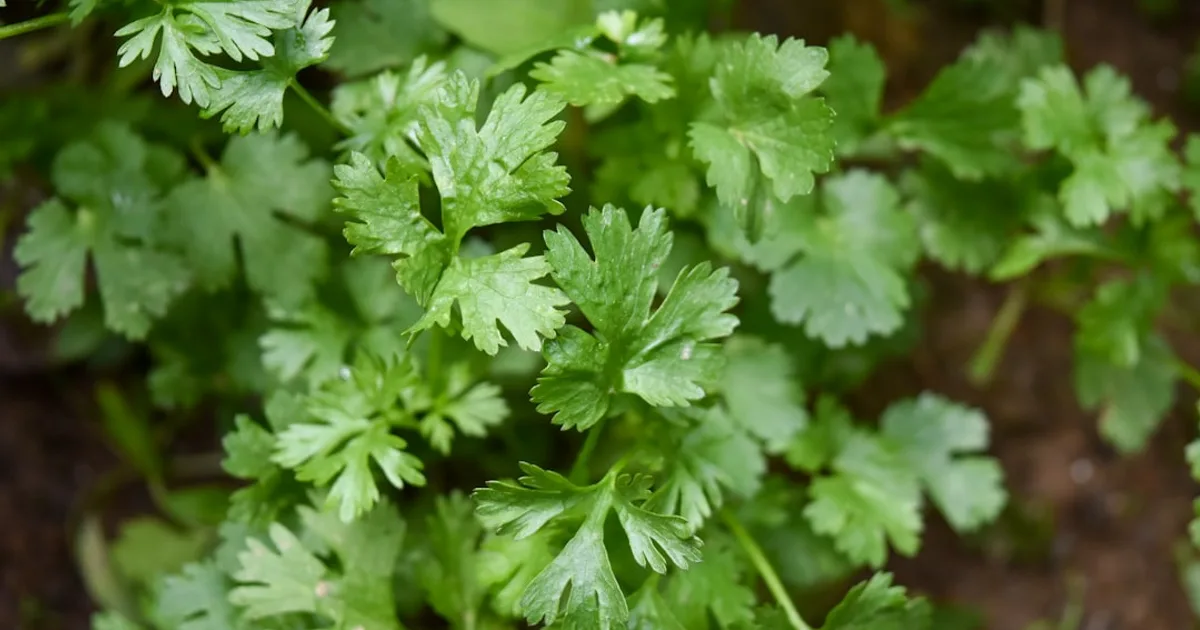
Parsley (Petroselinum crispum) is one of the most persistently undervalued garden plants. It’s slow to germinate, slow to establish, and then - once it does - it produces steadily for months, overwinters in most of the country, and comes back the following spring before bolting to seed. A single plant can provide fresh parsley from June through the following May in zone 6. That’s an 11-month harvest from one $2.49 seed packet.
Flat-leaf vs. curly: a real distinction
The species Petroselinum crispum includes two main groups. Italian flat-leaf parsley (P. crispum var. neapolitanum) has broad, flat, lobed leaves and stronger, more complex flavor - higher essential oil content, particularly myristicin and apiol. Curly parsley (P. crispum var. crispum) has tightly crimped leaves, milder flavor, and is primarily used as a garnish. The curly type was bred for visual appeal; the flat type is what actually belongs in the kitchen.
Chefs and restaurant buyers pay premiums for flat-leaf parsley. If you’re growing for flavor or market value, grow flat-leaf. Curly has its uses, but they’re decorative more than culinary.
| Feature | Flat-leaf (P. crispum var. neapolitanum) | Curly (P. crispum var. crispum) |
|---|---|---|
| Leaf shape | Broad, flat, deeply lobed | Tightly ruffled, compact |
| Flavor intensity | Strong, complex (myristicin/apiol) | Mild, slightly bitter edge |
| Essential oil content | Higher | Lower |
| Retail value | $5-8/lb | $3-5/lb |
| Primary culinary use | Chimichurri, gremolata, tabbouleh, cooking ingredient | Garnish, plate decoration |
| Restaurant market value | Premium - preferred by professional kitchens | Standard - common garnish |
| Both types? | Biennial, cut-and-come-again | Biennial, cut-and-come-again |
The difference in essential oil content is measurable: flat-leaf parsley has been documented at 0.1-0.3% essential oil by fresh weight, while curly parsley typically ranges 0.03-0.1% (Simon, J.E. et al., Herbs: An Indexed Bibliography, Archon Books). The flavor difference is real and not subtle. Grow flat-leaf for cooking; curly only if you specifically need the decorative form.
Both are true biennials: they grow vegetatively in year one, overwinter, then bolt to flower and seed in year two before dying. In zones 5 and below, treat them as annuals. In zones 6-9, the plants survive winter under a light mulch and resume growth in early spring, giving you a second flush of harvest before they send up flower stalks.
The ROI case
Fresh flat-leaf parsley at retail runs $3.00-$5.00 per bunch, with bunches weighing roughly 0.5-1.0 oz - that puts retail pricing at $5.00-$8.00/lb based on USDA AMS fresh herb price surveys. A well-managed plant in good soil will produce 0.5-1.0 lb across the full season. At $6.00/lb average, one plant returns $3.00-$6.00 in grocery value against a seed cost of a few cents per plant.
The real economic case isn’t in one season - it’s in the biennial cycle. A plant you start in spring of year one is still producing in spring of year two with no additional input. In zones 6+, your investment in seed is fully amortized across two growing seasons.
| Season | Start date | Harvest window | Yield | Value at $6/lb |
|---|---|---|---|---|
| Year 1 | April-May (seed start) | July-November | 0.4-0.6 lb | $2.40-3.60 |
| Year 1 winter | Overwinter (Zone 6+ under light mulch) | None | - | - |
| Year 2 spring | March-April (spring regrowth) | March-June (before bolting) | 0.2-0.3 lb additional | $1.20-1.80 |
| 2-year total | July-June (11 months) | 0.6-0.9 lb | $3.60-5.40 |
A single planting that overwinters represents 11 months of potential harvest from one $2.49 packet. At the low end, 0.6 lb at $6/lb is $3.60 - the seed packet pays for itself in year one, and the spring year-two flush is the bonus. Plants that winter poorly in zone 5 or warmer winters in zone 6 may not reliably overwinter, but the year-one production alone returns well against the seed cost.
Flat-leaf parsley also sells well at farmers markets. Restaurants buying fresh herbs will pay $1.00-$2.00 per bunch for consistent quality, making it one of the more practical cut herbs for small-scale sale.
Growing requirements
Parsley germinates slowly - 14 to 28 days is normal at 65-70°F soil temperature, and some gardeners report 30+ days (Cornell Cooperative Extension, Parsley, 2015). Soaking seeds in warm water for 24 hours before planting speeds germination by softening the seed coat. Don’t give up on a seeded bed after two weeks; the seeds are most likely fine.
Start seeds indoors 8-10 weeks before the last frost date, or direct sow as soon as soil can be worked in spring. Parsley tolerates light frost - established plants handle temperatures down to 20-25°F under light protection. Seedlings are cold-hardy once established.
Soil pH of 6.0-7.0. Parsley is a relatively heavy feeder for an herb - work compost into the bed before transplanting and apply a balanced liquid fertilizer monthly. Heavy nitrogen will drive rapid leaf growth but can reduce the essential oil concentration that gives flat-leaf its flavor. A balanced 10-10-10 granular at planting and modest subsequent feeding is more appropriate than heavy nitrogen programs.
Plant in a spot with 4-6 hours of direct sun. In zones 7+, afternoon shade extends summer productivity by keeping leaf temperatures lower and slowing bolting.
What goes wrong
Carrot weevil (Listronotus oregonensis) larvae bore into parsley taproots, causing wilting and plant death. The weevil is primarily a problem in the eastern United States and Canada. There is no post-infestation treatment; infected plants should be removed. Row cover at transplanting prevents adult weevil access.
Parsleyworm - the larva of the eastern black swallowtail butterfly (Papilio polyxenes) - feeds on parsley foliage and can consume a plant rapidly when populations are high. The caterpillars are visually striking (green with black and yellow bands) and will become a native butterfly. Hand-pick and relocate to wild carrot or Queen Anne’s lace if you’d rather not lose parsley production, or accept some defoliation given the ecological value.
Septoria leaf spot (Septoria petroselini) causes small tan spots with darker margins on leaves, most commonly in wet seasons. Remove affected lower leaves promptly. Good air circulation and dry foliage reduce spread.
Damping off (Pythium spp.) affects seedlings in overly wet germination conditions. Adequate drainage is the prevention.
Harvest and storage
Cut outer stems at the base of the plant, leaving the center growth intact. This is the standard cut-and-come-again method - never take more than one-third of the plant at once, and the center will regenerate. In warm weather, regrowth is rapid enough that you can harvest every 7-10 days from a healthy plant.
Fresh parsley keeps well in the refrigerator wrapped in a damp paper towel, or stored upright in water like a cut flower, for up to two weeks. For longer storage, chop and freeze in ice cube trays with water or olive oil. Dried parsley loses most of its volatile oils and is a poor substitute for fresh in most applications.
When the plant bolts in its second year, let one or two plants go to seed if you want seed-saving capability. Harvest seed heads when they turn brown and dry on the plant.
Culinary applications
Parsley is versatile - it works raw in salads and sauces, cooked in stocks and braises, and as a knife-skill test in dishes where consistent fine chopping matters. The key to using it well is knowing which applications need fresh flat-leaf and which can get by with dried or curly.
Chimichurri: the Argentine herb sauce for grilled meat. Standard ratio: 1 cup tightly packed flat-leaf parsley leaves, 3-4 garlic cloves, 2 tbsp red wine vinegar, 1 tsp dried oregano, 1/2 tsp red pepper flakes, 1/2 cup olive oil, salt. Pulse in a food processor to a rough paste - not completely smooth. This is a sauce that requires fresh flat-leaf; dried parsley produces a muddy green paste without the vegetal lift, and curly parsley is too mild. Chimichurri keeps refrigerated for 2 weeks.
Gremolata: the Italian garnish for osso buco. Equal parts finely chopped flat-leaf parsley, minced garlic, and lemon zest. Add raw at the moment of serving - the heat from the braised veal or pork drives the aromatics upward and into the sauce. This is one of the most economical uses of parsley: 2 tablespoons of parsley, one small clove of garlic, and zest from a lemon transforms a long braise in seconds.
Tabbouleh: the Middle Eastern salad where parsley is the main ingredient, not a garnish. Correct ratio is 2 cups flat-leaf parsley to 1/4 cup bulgur (soaked, not cooked), diced tomato, cucumber, green onion, lemon juice, and olive oil. Many American recipes invert this, making it a bulgur salad with some parsley. The herb is the point.
In cooking: parsley handles gentle heat better than most herbs - add to a braise in the last 15 minutes and it retains its green color and a portion of its flavor. Parsley stems are more intensely flavored than the leaves and are excellent in stocks and aromatics. Don’t throw away the stems.
Related reading: Companion Planting Basics - what the evidence actually says about common pairings; Organic Produce Cost Analysis - fresh herb retail prices and what home-grown replaces per season; Herb Garden ROI - parsley beats basil on gross value per plant
Frequently Asked Questions
What is the difference between flat-leaf and curly parsley?
Flat-leaf (Italian) parsley has stronger flavor and is preferred for cooked dishes and sauces. Curly parsley has milder flavor, better texture for raw garnish, and slightly better cold tolerance. Flat-leaf is the more valuable culinary crop at $6/lb retail.
Is parsley an annual or a perennial?
Parsley is a biennial - it grows vegetatively in year one and flowers in year two before dying. In zones 6 and warmer, it overwinters and provides fresh herb through spring of year two before bolting. You can get up to 18 months of harvest from a single planting.
Why is parsley slow to germinate?
Parsley seeds have naturally slow germination, taking 3 to 4 weeks at 70 degrees. Soaking seeds in warm water for 24 hours before sowing speeds this. Starting indoors 8 to 10 weeks before last frost gives transplants a strong head start on the season.
Growing Parsley? Track your harvest value and break-even date in the Garden ROI app.
Get the App