
Quince
Cydonia oblonga
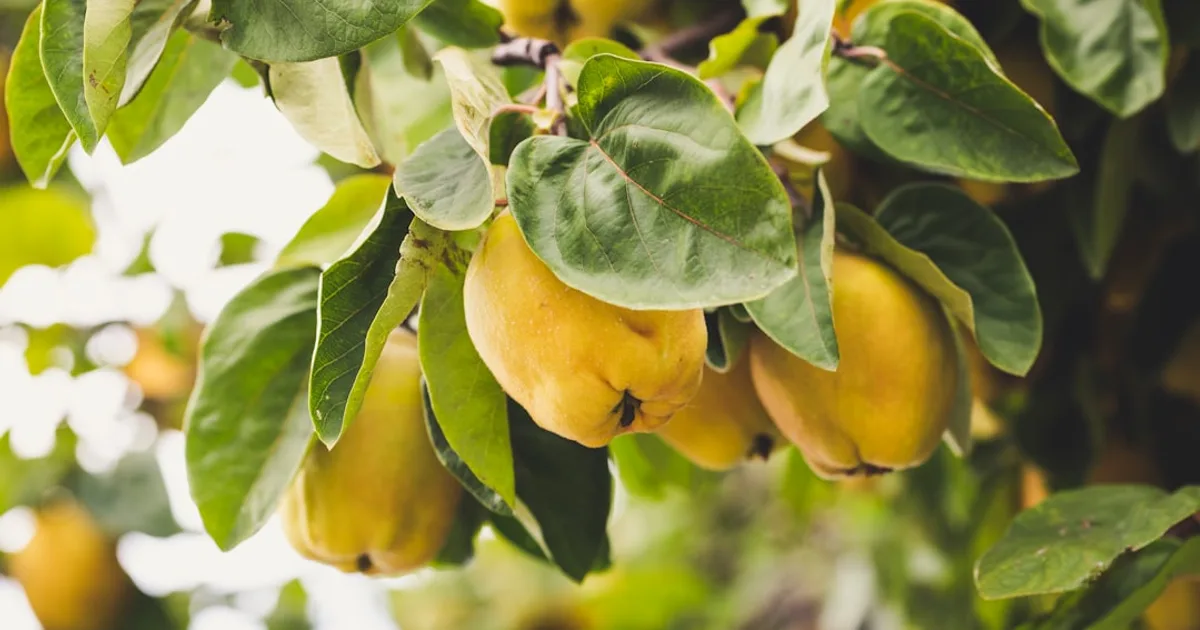
Quince occupies a strange position in American food culture: almost unknown in produce aisles, deeply embedded in every other food tradition. In the Middle East, Spain, Portugal, Latin America, France, and Central Asia, quince preserves, pastes, and braised preparations are kitchen staples. The fruit itself is astringent and nearly inedible raw, but something interesting happens when you cook it: the flesh turns deep rose-pink to ruby red and develops a flavor that is richer, more complex, and more aromatic than any apple or pear.
At the specialty stores and farmers markets that carry it, quince runs $4-8/lb in October and November - when it’s available at all. A mature quince tree produces 20-40 lb annually, is self-fertile, has minimal pest pressure compared to apple and pear, and tolerates a range of soil conditions that would stress other pome fruits. It’s one of the most underplanted useful trees in American gardens.
What it actually is
Cydonia oblonga is the only member of the genus Cydonia, a pome fruit in the family Rosaceae. It’s native to southwestern Asia (Transcaucasia, northern Iran, Turkey) and has been cultivated for at least 4,000 years. Greeks and Romans used it extensively; the “golden apple” of Greek mythology may have been a quince rather than an apple (Apicius, Book I; Wilson, Food and Drink in Britain, 1991).
The fruit resembles a lumpy, irregular pear or apple - yellow when ripe, covered in soft fuzz while developing. The flesh is extremely hard and grainy raw, high in tannins, and generally inedible uncooked. Cooking breaks down the tannins and activates a color reaction involving polyphenols - the same compounds responsible for the transformation to deep pink when simmered.
Key varieties:
| Variety | Fruit shape | Flavor notes | Season | Zones | Notes |
|---|---|---|---|---|---|
| Pineapple | Pear-shaped | Aromatic, fruity | Mid-season | 5-9 | Best raw-edible quince; still benefits from cooking |
| Smyrna | Apple-shaped | Rich, aromatic | Late | 6-9 | Large fruit; Turkish type |
| Champion | Apple-shaped | Mild, tender | Mid | 5-9 | Earliest to soften when cooked |
| Orange | Pear-shaped | Strong flavor | Late | 5-9 | Classic for membrillo; intense color change |
| Van Deman | Large, pear-shaped | Sweet, aromatic | Late | 5-9 | High yield; American selection |
The ROI case
Quince trees are long-lived (30-50+ years), self-fertile, and relatively fast to bearing - first fruit at year 3-4, significant production by year 5. The pest and disease pressure is lower than apple or pear in most climates, reducing spray inputs.
| Year | Yield estimate | Value @$5/lb | Cumulative value | Tree cost | Cumulative net |
|---|---|---|---|---|---|
| 1-2 | 0 | $0 | $0 | -$24.99 | -$24.99 |
| 3 | 4 lb | $20 | $20 | - | -$4.99 |
| 4 | 12 lb | $60 | $80 | - | $55.01 |
| 5 | 20 lb | $100 | $180 | - | $155.01 |
| 7 | 28 lb | $140 | $440 (est.) | - | $415.01 |
| 10 | 32 lb | $160 | $740 (est.) | - | $715.01 |
Membrillo production (quince paste, described below) commands $15-25/lb at specialty food stores. 5 lb of fresh quince yields approximately 2 lb of membrillo. At $20/lb for quality membrillo, 5 lb of fresh fruit becomes $40 of value-added product.
Growing requirements
Climate: quince is one of the more adaptable pome fruits. It tolerates heavier, wetter soils than apple and pear. It blooms 1-2 weeks after apples, reducing late-frost risk in marginal climates. Cold-hardiness to approximately -15°F (-26°C) in dormancy; zones 5-9.
Self-fertility: quince is self-fruitful - one tree produces a full crop. Cross-pollination with a second tree can improve fruit set and size but isn’t required.
Soil: tolerates heavy soils and brief waterlogging that would damage peaches or cherries. Prefers slightly acidic to neutral pH (6.0-7.0) but performs acceptably at pH 5.5-7.5. Avoid highly alkaline soils.
Pruning: quince bears fruit on the tips of new growth and on short spurs. Training to an open center form (similar to peach) or modified central leader works. Annual thinning of crossing branches and water sprouts maintains productivity. Quince is vigorous and reshoots readily after hard pruning.
Fireblight resistance: quince is susceptible to fireblight (Erwinia amylovora), though typically less severely than pear. Prune out blighted wood during dry weather, cutting 12 inches below the visible infection; sterilize pruning tools between cuts with 70% isopropyl alcohol.
What goes wrong
Fireblight is the most serious disease problem. New shoot tips wilt suddenly and turn brown to black, with a characteristic shepherd’s crook shape. In susceptible conditions (warm, wet spring during bloom), entire branches can be lost quickly. Preventive copper spray at pink bud and at bloom reduces incidence. Select resistant varieties (‘Aromatnaya’, ‘Kuganskaya’) in high-pressure areas.
Quince leaf blight (Diplocarpon mespili / Entomosporium): brown spots on leaves causing premature defoliation. Same disease that affects pear. Copper-based spray at bud break; remove fallen leaves.
Codling moth (Cydia pomonella): same pest that attacks apple and pear. Larvae bore into fruit. Codling moth pheromone traps to monitor emergence; Surround (kaolin clay) spray at petal fall and continuing through summer to deter egg-laying.
Poor fruit set in cold, wet springs: quince blooms relatively late but can still lose flowers to late frosts. Also, wet and cold weather during bloom reduces bee activity and pollination. Usually self-corrects in normal weather years.
Quince fruit is harmless raw but unpleasant: not a pest or disease problem, but first-time growers sometimes taste the raw fruit and assume something is wrong. The astringency and hard texture are characteristic. Cooking is required.
Harvest and use
Harvest in October-November when the skin is fully yellow and the fruit detaches from the branch with slight pressure. Don’t rush the harvest - quince continues improving on the tree well into fall. Ripe quince has a strong, distinctive fragrance - floral, tropical, almost guava-like. This scent is the main indicator of ripeness alongside skin color.
Store at room temperature or refrigerated. Quince keeps longer than most fruit - 2-3 months at 35-40°F. They can be stored alongside apples, which absorb some of the quince fragrance.
Preparing: peel with a vegetable peeler; quince doesn’t brown as fast as apple after cutting. The flesh is extremely hard - use a sturdy knife and a stable cutting board. Core with a melon baller or pairing knife.
The color transformation: when quince is cooked, especially with sugar, the white-cream flesh turns progressively deeper pink to ruby red. This happens because polyphenols (leucoanthocyanins) oxidize during cooking and produce anthocyanin pigments. The longer and more acidic the cooking environment, the deeper the color. This is not a sign of spoilage - it’s the whole point.
Core preparations:
-
Membrillo (quince paste / quince cheese): the definitive quince preparation in Iberian and Latin American cooking. Cook peeled, cored quince with equal weight of sugar and a little lemon juice until very thick, stirring constantly, until the paste pulls from the sides of the pot (about 1 hour). Pour into a greased pan; dry further in a 150°F oven for 1-2 hours. The paste sets firm, slices cleanly, keeps for months. Served with Manchego or aged cheddar - the combination is extraordinary.
-
Quince paste (cotognata, Italian style): same concept as membrillo, slightly different spicing (often includes vanilla and cinnamon).
-
Poached quince: halves simmered in wine, sugar, and spices (cinnamon, cardamom, star anise) until tender and deep pink. Served as a dessert with cream or alongside roasted pork. The poaching liquid becomes a fragrant syrup.
-
Quince jelly: high pectin content makes quince ideal for jelly without added commercial pectin. Simmer quince (don’t peel or core - the pectin is in the seeds and core), strain through a jelly bag, cook with sugar until it gels. The resulting jelly is brilliant pink-rose.
-
Slow-roasted with lamb: Middle Eastern and Persian tradition. Quince braised with lamb and warm spices (cinnamon, turmeric, saffron). The quince absorbs the meat juices and becomes tender; the meat benefits from the quince’s acid.
Related reading: Pomegranate - fellow ancient fruit of Middle Eastern origin; Pear - related pome fruit with overlapping seasons
Growing Quince? Track your harvest value and break-even date in the Garden ROI app.
Get the App