
Pear
Pyrus communis
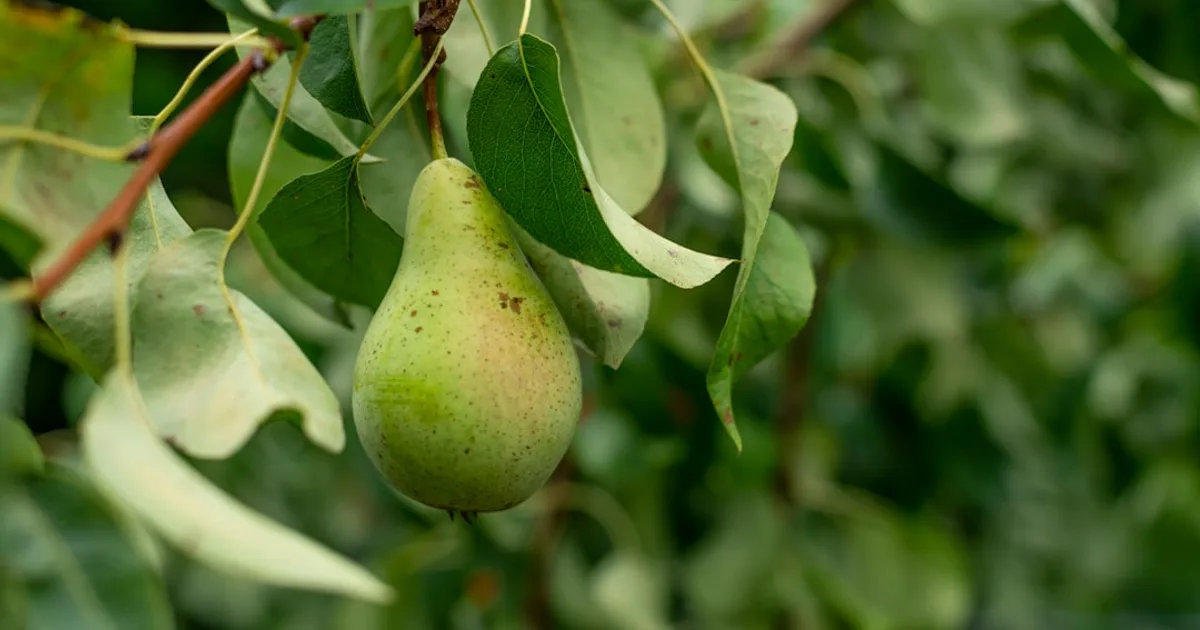
Pear is the most underplanted backyard tree fruit in the United States, and the reason is almost certainly fire blight. That reputation is partly deserved and partly outdated. Choose the right cultivar in the right region and a pear tree requires less spraying than an apple and produces fruit the grocery store doesn’t carry. Choose wrong and you’re cutting out dead wood every August while your neighbor’s Bartlett drips with fruit. The cultivar decision is everything.
European vs. Asian pear
These are two distinct species with different growing habits, different harvest timing, and fruit that is used in entirely different ways.
European pear (Pyrus communis) is what most Americans picture when they hear the word pear - the classic teardrop shape, buttery soft texture, the kind that runs down your chin when fully ripe. The defining characteristic of European pear is that it does not ripen on the tree. You harvest it mature-green, before softness develops, and ripen it off the tree at room temperature (65-70°F). Leave a European pear on the tree until it appears ripe and the interior will be mealy, brown, and grainy from the inside out - a process called core breakdown that makes the fruit inedible (Cornell Cooperative Extension, Tree Fruit for the Home Garden, 2019).
Key European cultivars and how they differ:
- Bartlett (also sold as Williams Bon Chrétien): the most widely grown pear in the world, accounting for about 65 percent of US commercial production (USDA National Agricultural Statistics Service, Noncitrus Fruits and Nuts Summary, 2023). Yellow-green to golden at harvest; ripen off-tree in 5-7 days at room temperature. Good for fresh eating and canning. Moderately susceptible to fire blight.
- Bosc: russet-brown skin, long tapered neck, dense firm flesh that holds its shape during baking and poaching. Harvest late - typically September into October in Zone 6. Cold-store at 32°F after harvest and it will hold 3-4 months (Penn State Extension, Pear Storage and Ripening, 2021).
- D’Anjou: green to yellow-green at harvest; the flesh won’t turn yellow when ripe, so pressure testing is the reliable ripeness indicator - it’s ready when it yields to gentle thumb pressure near the stem. Cold-stored at 32°F, D’Anjou holds until February. This is the variety that makes most of the late-winter grocery store pears you see, and home storage largely eliminates that supply chain.
- Comice: considered the best-tasting fresh-eating pear by most tasters for its high sweetness, low astringency, and cream-soft texture. Difficult to find in stores because it bruises easily and ships poorly. That is precisely why it belongs in your yard and not in a commercial operation. Moderate fire blight susceptibility.
Asian pear (Pyrus pyrifolia) operates on different rules entirely. Asian pears ripen on the tree. You leave them there until they taste right. They do not continue to ripen after picking, and they do not go through the off-tree ripening window that European pears require. The texture is crisp - more like a firm apple than a soft European pear - and that crispness persists through storage. They are excellent fresh and in salads but perform poorly for canning or baking because the cell structure does not break down softly with heat.
Key Asian cultivars:
- Hosui: golden-brown skin, high Brix (sugar content), widely regarded as one of the best-flavored Asian pears; susceptible to fire blight, so site selection matters in humid climates.
- Shinko: similar to Hosui but with better fire blight resistance; reliable producer in the East.
- Twentieth Century (also called Nijisseiki): yellow skin, mild sweet flavor, crunchy texture; one of the most widely planted Asian pears globally. Requires thinning to size fruit properly.
One practical point: Asian pears can cross-pollinate European pears, which matters for growers with limited space. The bloom timing overlaps enough that a Bartlett and a Hosui planted within 50 feet can serve as each other’s pollinator (Cornell Cooperative Extension, Tree Fruit for the Home Garden, 2019). This gives small-yard growers a way to satisfy the two-cultivar requirement while getting both texture types in the same planting.
Disease comparison to apple
Fire blight (Erwinia amylovora) is a bacterial disease that kills shoot tips and branches, giving infected wood the scorched, shepherd’s-crook appearance that gives the disease its name. It is the primary reason pears develop a reputation for difficulty, and it deserves a direct comparison to what apple growers deal with.
Apples in the Eastern US face three disease pressures that require routine spray programs: apple scab (Venturia inaequalis), cedar-apple rust (Gymnosporangium juniperi-virginianae), and fire blight. A conventional apple program in New York or Pennsylvania might involve 8-12 fungicide and bactericide applications per season. Remove any one disease from consideration and the spray burden drops sharply (Cornell NYSAES, Scaffolds Fruit Journal, spray programs for home orchardists, 2022).
European pears do not get apple scab. They are susceptible to a pear-specific scab (Venturia pirina) but it is generally a minor problem in most US regions. They have limited susceptibility to cedar-apple rust. The fire blight threat is real, but it is manageable through cultivar selection.
Resistant European cultivars: Kieffer (old American variety, gritty texture but nearly immune to fire blight; primarily for preserves), Harrow Sweet (developed by Agriculture and Agri-Food Canada specifically for fire blight resistance; good fresh eating quality; reliable producer in humid climates), and Moonglow (moderate resistance, soft flesh, good for fresh eating).
Asian pears carry generally lower fire blight susceptibility than most European cultivars. Shinko and Niitaka are specifically noted for resistance in Oregon State University Extension trials (OSU Extension, Asian Pear Production, EC 1639, 2019).
In the Pacific Northwest - west of the Cascades and in the mountain West where summers are dry - fire blight pressure is low enough that pear production often requires zero fungicide applications. The disease needs warm, wet weather during bloom; where that combination doesn’t occur, the risk is low (Oregon State University Extension, Managing Fire Blight in Oregon Pear Orchards, EM 8803, 2018). Eastern and Gulf Coast growers need resistant cultivars and should avoid heavy nitrogen applications, which produce the succulent new shoot growth that is most susceptible to infection.
If you are in a high-pressure region (humid East, mid-Atlantic, Southeast), this is the hierarchy: Harrow Sweet or Magness for European types, Shinko or Seuri for Asian. Bartlett and Comice are excellent pears that require management you may not want to do.
Pollination requirement
Most pears require a second cultivar within 50 feet for adequate cross-pollination. This is not a suggestion. A single pear tree planted alone will set some fruit in a good year and almost none in a bad year. Cross-pollination is the difference between a tree that earns its space and one that produces eight pears every other summer.
The practical cost of the two-tree requirement is real: you are committing space, water, and money to two trees rather than one. A dwarf tree pair at $35-50 each puts the initial cost at $70-100 before any amendments or infrastructure. You’re also managing two pruning schedules, two disease-monitoring targets, and two harvest windows that may not align.
Notable partial exception: Seckel is the most self-fertile European pear commercially available - a single tree will produce fruit without a pollinator in most years. Seckel is a small, spicy-sweet heirloom variety, excellent for fresh eating and preserves, that tolerates a range of conditions. It’s not as productive as Bartlett but it does not require a companion tree to function. If you have room for only one tree, Seckel is the honest choice (Cornell Cooperative Extension, Varieties for the Home Orchard, 2020).
Bloom time compatibility matters when choosing your two trees. Early-blooming and late-blooming cultivars won’t effectively cross-pollinate each other. Bartlett, Bosc, and D’Anjou are all mid-season bloomers that work together. Seckel is an early-to-mid bloomer that crosses with Bartlett. Asian varieties generally bloom mid-to-late and are compatible with most European mid-season types. Avoid pairing early-blooming Clapp’s Favorite with a late-blooming variety and expecting reliable cross-pollination.
10-year ROI for a dwarf pear tree
Dwarf pear trees on dwarfing rootstocks (Old Home x Farmingdale series, Quince A) begin bearing earlier than standard trees and produce 80-100 lb at full maturity. The tradeoff is a shorter productive life (15-25 years vs. 40-60 for standard) and the need for support staking since the rootstock does not anchor as firmly.
The following table uses a single dwarf European pear tree. Retail pear price: $2.00/lb, based on USDA Economic Research Service, Fruit and Tree Nut Yearbook, Table 3-4, average retail fresh pear price 2020-2023.
| Year | Harvest (lbs) | Annual Fruit Value | Annual Costs | Cumulative Net |
|---|---|---|---|---|
| Year 0 | 0 | $0 | $50 (tree) + $15 (planting supplies) = $65 | -$65 |
| Year 1 | 0 | $0 | $5 (mulch, irrigation) | -$70 |
| Year 2 | 0 | $0 | $5 | -$75 |
| Year 3 | 0 | $0 | $5 | -$80 |
| Year 4 | ~10 lbs | $20 | $5 | -$65 |
| Year 5 | ~30 lbs | $60 | $5 | -$10 |
| Year 6 | ~60 lbs | $120 | $5 | +$105 |
| Year 7 | ~80 lbs | $160 | $5 | +$260 |
| Year 8 | ~100 lbs | $200 | $5 | +$455 |
| Year 9 | ~100 lbs | $200 | $5 | +$650 |
| Year 10 | ~100 lbs | $200 | $5 | +$845 |
Break-even occurs in Year 5 on this model. By Year 10, the single tree has returned approximately $845 in net fruit value above all costs. If you planted two trees for cross-pollination, double the initial cost and the fruit value - the break-even stays in the same range and the net 10-year return roughly doubles.
Full production figures (80-100 lb) are consistent with USDA ARS National Clonal Germplasm Repository data for dwarf European pear on OHxF 87 rootstock and with Penn State Extension projections for mature semi-dwarf home plantings (Penn State Extension, Home Fruit Production: Pear, 2022). The zero-yield years 1-3 are the standard establishment window; some plantings see first fruit in year 3 from a 2-year nursery tree, which slides the break-even earlier.
Annual cost of $5 in years 1-10 assumes no disease spray program. If you’re in a fire-blight-pressure region and chose a susceptible cultivar, add $20-40/year for copper bactericide applications at bloom. That pushes break-even to year 6 but does not change the long-term return.
Harvest and storage
The most important thing to know about European pears is that picking too late ruins them. Harvest mature-green, before any softening, typically when the fruit separates easily from the spur with an upward twist - called the “lift test.” If you have to tug, it’s not ready or you’re pulling wrong. The skin color on most varieties has shifted slightly from deep green toward yellow-green; the lenticels (small dots on the skin surface) become more pronounced. These are visual cues, not conclusions - the lift test and a pressure check with your thumb are more reliable.
Once picked, bring European pears indoors and let them ripen at 65-70°F. Bartlett takes 5-7 days from a mature-green harvest. D’Anjou takes longer - 7-10 days at room temperature. Check daily. The fruit is ready when it yields to gentle pressure near the stem and the aroma is apparent. At that point, eat it the same day or refrigerate it for 2-3 more days at most.
For longer storage, you have two options. First: delay ripening by cold-storing the fruit immediately after harvest at 32-35°F before bringing it to room temperature to ripen on demand. Bosc and D’Anjou hold at cold storage for 3-5 months this way (Penn State Extension, Pear Storage and Ripening, 2021). Second: can or preserve. Pears hold their texture better through the canning process than many soft fruits. Bartlett and Bosc are standard for preserves.
This is where home production has a concrete advantage over store-bought. The commercial pear supply is dominated by varieties selected for shipping durability and uniform appearance, not flavor or storability in a home context. D’Anjou holds until February in your basement refrigerator. Comice is almost never available commercially because it bruises. Harrow Sweet is unknown at retail. The varieties available to you as a home grower are simply not the same varieties you can buy.
Asian pears store well in their own right - 2-3 months at 32°F for most cultivars without any off-tree ripening required. Shinko and Hosui will hold well into winter from a late-summer harvest.
What goes wrong
Fire blight is addressed above under cultivar selection. If you see the shepherd’s-crook die-back, prune the affected wood 12 inches below visible symptoms into clean wood, disinfect your pruning tool with 10 percent bleach solution between cuts, and dispose of the removed material - do not compost it. Bacterial ooze is infectious; a tool used on a blighted branch and then used on healthy wood spreads the disease mechanically.
Pear psylla (Cacopsylla pyricola) is the primary insect pest of pears in the US and is specific to pear - it does not attack apple or other fruits. Adults overwinter in bark and debris; nymphs feed on developing leaves and fruit, excreting honeydew that supports sooty mold growth. Dormant oil applications before bud break in late winter control overwintering adults effectively (Cornell NYSAES, Pest Management Guidelines for Commercial Tree Fruit, 2023). At the home scale, a single dormant oil spray in March is usually sufficient management.
Codling moth (Cydia pomonella) affects pear just as it does apple. The larvae tunnel into fruit, leaving the characteristic “wormy apple” damage. Pheromone trap monitoring tells you when adult flight peaks (degree-day accumulation from biofix); insecticide applications timed to coincide with egg hatch control it. Kaolin clay (Surround WP) provides physical barrier protection and is suitable for organic programs.
Fabraea leaf spot (Fabraea maculata, also called leaf blight) affects pear primarily in humid conditions, causing dark spots on leaves and fruit. It is not the same pathogen as pear scab. Copper fungicide applications in late spring and early summer, combined with prompt removal of fallen leaves, manage it at the home scale (Penn State Extension, Fabraea Leaf Spot of Pear, 2020).
Poor drainage is the other common failure mode. Pear roots in saturated soil develop crown rot (Phytophthora spp.) and the tree declines slowly over several seasons before the grower realizes the planting site is the problem. Plant in well-drained soil with a pH of 6.0-6.5. If you’re on clay, plant on a slight mound or raised bed section to ensure the root zone drains. Unlike blueberry, pear does not tolerate acid soil below pH 5.5 and will show iron chlorosis in the same conditions that blueberries require.
Related crops: Apple, Blueberry, Fig
Related reading: First Three Years ROI - accounting for the establishment window before a tree fruit planting produces at full capacity; Fruit Tree Payback Timeline - when each tree covers its cost
Growing Pear? Track your harvest value and break-even date in the Garden ROI app.
Get the App