
Thai Basil
Ocimum basilicum var. thyrsiflora
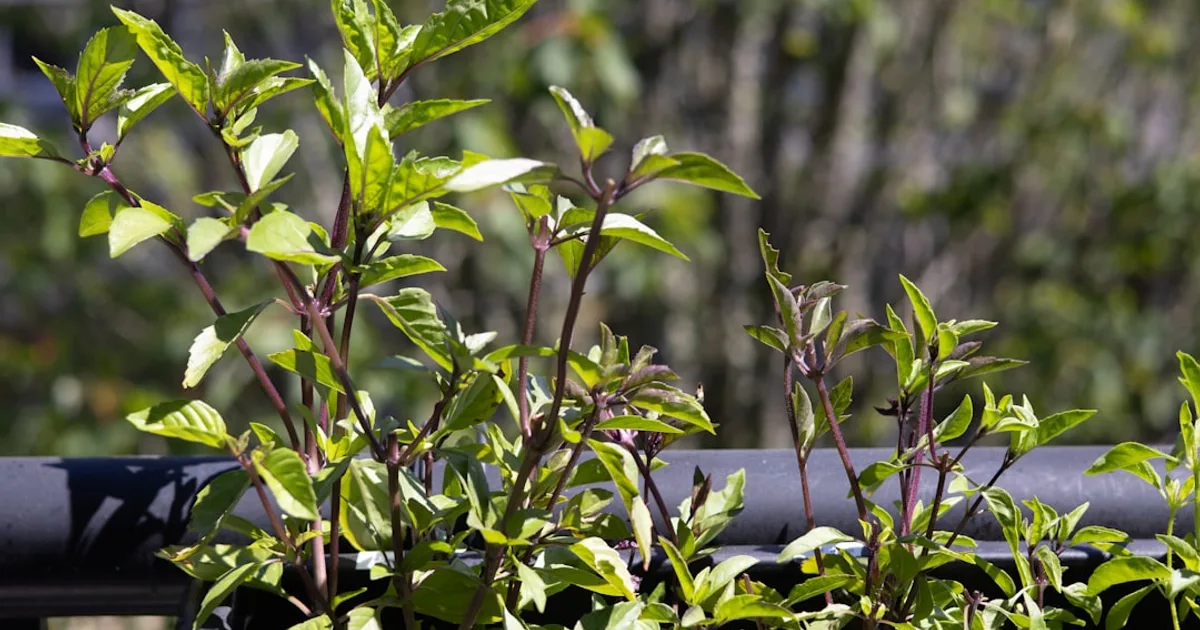
Thai basil costs $18 a pound at Asian grocery stores, and most supermarkets don’t carry it at all. That combination - high retail price, low availability - is the whole ROI argument in two facts.
What you’re actually growing
Thai basil is Ocimum basilicum var. thyrsiflora, a distinct botanical variety within the sweet basil species, but it is not sweet basil in any practical sense. The leaves are narrower and stiffer than Genovese types, with a waxy surface that holds up to heat. The stems are purple, not green. And the flavor is fundamentally different chemistry: Thai basil gets its anise-licorice character from methyl chavicol (estragole), the same aromatic compound that defines fennel seed and star anise. Sweet basil is dominated by linalool, which produces the sweeter, more floral Italian-cooking aroma.
James Duke’s Phytochemical and Ethnobotanical Databases (Dr. Duke’s Phytochemical and Ethnobotanical Databases, USDA-ARS) document the chemotype variation across Ocimum basilicum in detail. Thai basil falls into the methyl chavicol-dominant chemotype; Genovese sweet basil is linalool-dominant. These are not interchangeable in cooking any more than fennel seed and fresh Italian basil are interchangeable. A Thai green curry made with sweet basil will not taste right. A caprese salad finished with Thai basil will taste like anise. The plants look similar enough in a garden center that the mistake is easy to make - don’t make it.
Also in the market under the “Thai basil” name: holy basil (Ocimum tenuiflorum), sometimes sold as “hot basil” or “bai krapao” at Southeast Asian grocers. That is a separate species with a clove-pepper flavor driven by eugenol. In Thai cuisine, thyrsiflora and tenuiflorum have entirely separate applications - thyrsiflora goes into curries and noodle dishes; tenuiflorum goes into stir-fries and pad krapao. If you buy seeds, read the botanical name. Common names alone will mislead you.
The ROI case
At Asian grocery stores, Thai basil typically sells in small bunches at $1.50–$2.99 per bunch. Weigh those bunches and you’re usually looking at 2–4 oz of leaf and stem - which works out to $12–$24 per pound. The $18/lb figure used here is a conservative midpoint, consistent with USDA Agricultural Marketing Service specialty herb price ranges for fresh Asian culinary herbs. At natural food retailers and upscale grocery chains where Thai basil does appear, prices run $20–$25/lb.
The worked calculation: 0.5 lb seasonal yield (the planning estimate used by most cooperative extension services for well-managed culinary herb plants) at $18/lb = $9.00 gross return. Subtract $3.49 for the seed packet, which contains far more seeds than you’ll use in a season. Net return: $5.51. That is a 2.6x ROI multiple on seed investment for a single season.
Sweet basil by comparison: $14.99/lb at conventional retail, widely available in every supermarket. The Thai basil premium exists because supply is thinner - the crop has a more limited commercial growing base in the United States. For a home grower, that limited supply is structural advantage. You can grow what most grocery stores don’t carry.
If you keep a plant pinched and productive through a full summer, 0.5 lb is a floor, not a ceiling. A well-managed plant in full sun can push 0.75–1.0 lb across the season. At 1.0 lb and $18/lb, you’re at $14.51 net after seed cost.
Varieties worth knowing
Not all Thai basil seed sold in the US is the same. Three types appear most commonly:
| Variety | Habit | Leaf | Notes |
|---|---|---|---|
| ’Siam Queen’ | Compact, 18–24 in. | Large, dark green | AAS Award winner 1997; most widely available; best leaf-to-stem ratio for culinary use |
| ’Cardinal’ | Upright, 24–30 in. | Medium, glossy | Prominent purple-red flower spikes; ornamental value but lower harvest yield per pinch |
| Thai market types (unselected) | Variable | Smaller, narrower | Traditional types offered by Kitazawa Seed Co.; closer to what you find at Asian grocers; less uniform but authentic flavor profile |
‘Siam Queen’ is the practical choice for most home growers. The All-America Selections designation reflects performance across a range of growing conditions, and the compact habit makes pinching and harvesting efficient. If you’re growing in containers, ‘Siam Queen’ handles restricted root space better than taller types.
‘Cardinal’ produces attractive flowering stems that extend the harvest if you let them go - but letting them go is exactly the wrong move for leaf production. It’s a better choice if you want the plant for ornamental use and treat the leaf harvest as secondary.
The unselected Thai market types from specialty seed suppliers like Kitazawa Seed Company are worth a trial if flavor authenticity matters more to you than uniformity. Kitazawa has been supplying Asian vegetable and herb seed in the US since 1917; their selection tracks what’s actually grown in commercial Asian herb production.
Growing requirements
Thai basil is a tropical plant. It wants heat, full sun, and will not forgive frost. The cultural requirements are nearly identical to sweet basil, with a few real differences.
Start seeds indoors 6 weeks before your last frost date. Germination at 70–75°F soil temperature takes 7–10 days. Do not direct sow; Thai basil started outdoors after soil warms will establish, but you lose four to six weeks of productive season. An indoor start gives you plants large enough to harvest within a few weeks of transplanting.
Transplant after soil temperature reaches 60°F and nighttime lows are reliably above 50°F. Below 50°F at night, basil suffers chilling injury - the leaves don’t blacken immediately, but cell damage accumulates and the plant never fully recovers its growth rate. UC Cooperative Extension’s Basil Production in California (ANR Publication 7240) documents this threshold clearly, and it applies to Thai basil the same as sweet basil.
Full sun means six or more hours of direct sun per day. Thai basil will survive partial shade but won’t yield well. In partial shade you get lanky stems, reduced essential oil concentration, and a flavor that’s noticeably flatter than sun-grown leaf. This is not a crop to tuck into a north-facing corner.
Soil pH of 6.0–7.0 works well. Drainage is more important than fertility. Waterlogged roots invite fusarium wilt faster than any other disease pressure you’ll encounter. If you’re planting in-ground clay soil, work in two to three inches of compost before planting. Raised beds with mixed growing media drain reliably and are the better option if you’ve had fusarium problems in previous seasons.
Fertilize lightly. A balanced granular fertilizer at planting, plus a diluted liquid fertilizer monthly, is sufficient. Over-fertilizing with nitrogen pushes vegetative growth but dilutes the aromatic oil concentration - the methyl chavicol content that makes the herb worth growing is inversely related to how lush and fast you push the plant (Penn State Extension, Herb Production, 2019 covers this mechanism for aromatic herbs generally).
One practical advantage Thai basil holds over sweet basil: it bolts more slowly under sustained heat. Once summer temperatures are consistently in the 85–95°F range, Genovese sweet basil initiates flowering quickly and production becomes difficult to maintain. Thai basil’s firmer leaf structure and slower bolt response mean you’re doing less continuous flower-pinching work in the height of summer. This is a real difference, not marginal.
Pinching and harvest management
Pinch the central growing tip as soon as the plant has three to four sets of true leaves. Cut above the second or third leaf node. This redirects growth energy into lateral branches and turns a single-stemmed seedling into a productive bushy plant. After that, the job is continuous: every time a flower spike appears, remove it.
Thai basil flowers are distinctive - small white or pale purple flowers on upright spikes above the foliage. They appear earlier in the season than you’d expect. Pinch them off immediately. Once seed set begins, leaf production slows, and the remaining leaves become tougher and slightly more bitter. The plant wants to reproduce; your job is to prevent it from doing so for as long as possible.
The firmer, waxy leaves of Thai basil make harvest physically easier than sweet basil. The leaves don’t bruise as readily, and a clean cut above a leaf node results in reliable branching from that point. Harvest by cutting stems four to six inches down, above a clearly visible leaf pair. Morning harvest after dew dries and before midday heat gives you the best essential oil concentration - methyl chavicol is volatile and dissipates as the plant heats up through the day.
Culinary applications
Thai basil’s role in Southeast Asian cooking is specific and not reducible to “add basil to this dish.” It is a finishing herb and a key aromatic in several preparations where the anise note is structural, not incidental.
In Thai green and red curries, whole Thai basil leaves are added in the final minute of cooking - the heat wilts them slightly without destroying the flavor. Massaman curry, which has a more complex spice profile, uses Thai basil more sparingly. In Vietnamese pho, a plate of fresh Thai basil is served alongside for the diner to tear and add directly to the bowl. Larb (Lao/Thai minced meat salad) uses Thai basil as one of the primary fresh herb components.
The flavor is strong enough to hold up to hot liquid and fat in a way that Italian basil cannot. This is why Thai basil is added to curries and pho, and sweet basil is not. The methyl chavicol-dominant profile persists briefly through heat exposure; linalool, the dominant compound in sweet basil, volatilizes faster and loses its character almost immediately when cooked.
Do not substitute sweet basil in these preparations expecting similar results. The flavor chemistry difference is real and detectable.
What goes wrong
Thai basil shares most of the disease and pest pressure of sweet basil.
Basil downy mildew (Peronospora belbahrii) is the primary disease concern in humid eastern US climates. It appears as yellow patches on upper leaf surfaces with gray-purple sporulation on the undersides - the underside sporulation distinguishes it from nitrogen deficiency, which produces yellowing without the fuzzy underside growth. Cornell Plant Pathology research (Wyenandt et al., Plant Disease, 2010) documents race variation in the pathogen. Good airflow between plants is the primary preventive measure. Water at the root zone, not overhead. Remove affected plants immediately and do not compost them.
Fusarium wilt (Fusarium oxysporum f.sp. basilici) causes sudden wilting, often of a single branch first. If you cut the stem of a wilted branch, you’ll see brown discoloration in the vascular tissue. It’s soilborne and will persist in the soil for multiple seasons. There is no treatment. Rotate basil out of beds where you’ve had fusarium wilt, and consider fusarium-tolerant cultivars in subsequent seasons.
Japanese beetle (Popillia japonica) is a significant defoliator where populations are high. Hand-picking in the morning when beetles are sluggish is the most practical approach for a small planting. Pheromone traps attract more beetles than they catch and are counterproductive in or near the garden.
Aphids colonize new growth and produce honeydew that leads to sooty mold. A hard water spray removes most colonies effectively. Insecticidal soap for heavier infestations. Check the undersides of leaves during the cool, early-season period when aphid pressure is highest.
Harvest timing and storage
Harvest in the morning. This is worth repeating: methyl chavicol and the other aromatic volatiles in Thai basil dissipate with heat and mechanical disruption. Morning harvest before temperatures rise gives you the most flavorful product.
Use within 48 hours of harvest for full flavor. The volatile chemistry dissipates faster post-harvest than it does with linalool-based sweet basil. This rapid volatilization is part of why commercially distributed Thai basil is less flavorful than what you grow and harvest fresh - the supply chain is working against you even in a well-run Asian grocery.
For storage beyond 48 hours: stand cut stems upright in a glass of water at room temperature, covered loosely with a plastic bag. Do not refrigerate; chilling injury blackens the leaves and accelerates flavor loss. Basil keeps best at 65–68°F.
For longer storage, freeze. Blend fresh leaves with just enough neutral oil to make a coarse paste and freeze in ice cube trays. The color darkens but the methyl chavicol survives freezing better than drying. Dried Thai basil loses most of its characteristic flavor; it is useful for long-cooked applications where you need the aromatic note but can live with the muted version. For finishing a pho bowl or a curry, dried Thai basil is a poor substitute for fresh.
Companion planting context
Thai basil is commonly listed as a companion for tomatoes and peppers, and these pairings are practical for spatial reasons if nothing else - they share heat and full-sun requirements, so they can share a bed without competing for different environmental conditions. The volatile compounds from basil, including methyl chavicol and linalool, have demonstrated repellent effects on Spodoptera species and aphids in laboratory studies (Hummelbrunner & Isman, Journal of Chemical Ecology, 2001). Consistent field-scale yield benefits have not been reliably demonstrated. Grow them together because it’s convenient and uses the bed efficiently. Don’t rely on the pest deterrence as a stand-alone control strategy.
Related crops: Basil, Hot Pepper
Related reading: Herb Garden ROI - the 8 highest-value culinary herbs compared
Growing Thai Basil? Track your harvest value and break-even date in the Garden ROI app.
Get the App