
Onion
Allium cepa
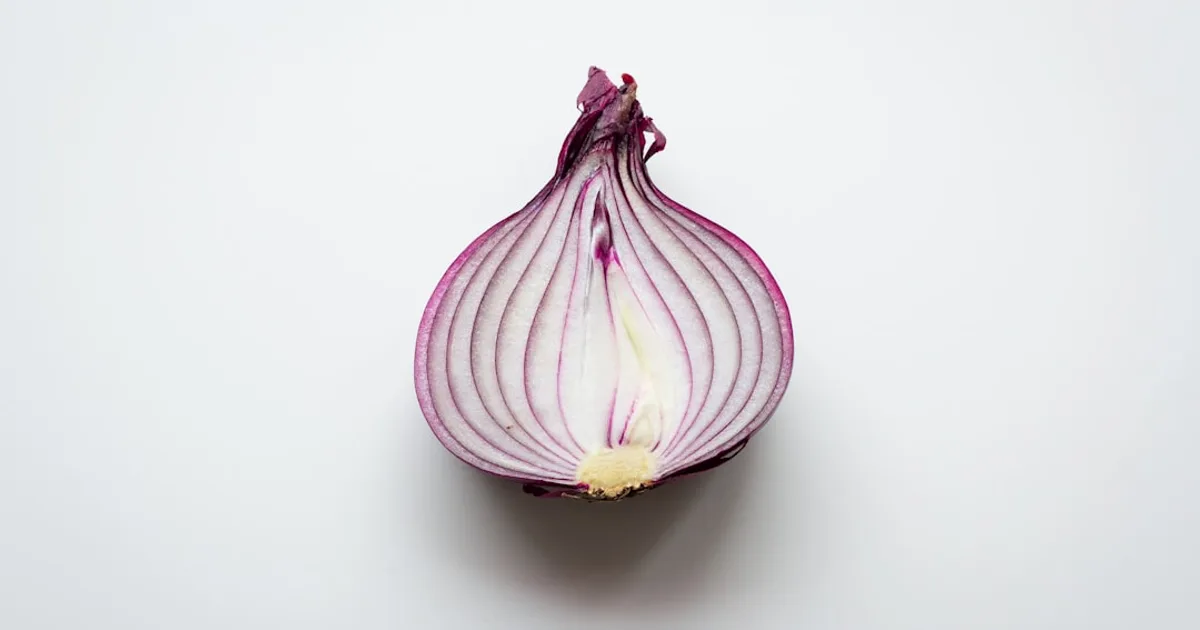
Onions (Allium cepa) are fundamentally a storage crop, and that’s what separates their ROI math from crops you eat immediately. A tomato has to be consumed within days of harvest. An onion harvested in August sits in a cool pantry until February. That 6-month storage window means the value doesn’t disappear if you have more than you can use in a week - which is almost always the case with a productive bed.
Sets, transplants, or seeds
Three methods, each with very different economics:
Sets are small, marble-sized dry bulbs grown the previous year. They’re the most common home garden starting point. A bag of 50–100 sets runs $3–$5. Sets establish quickly and tolerate light frost after planting. The drawback: varieties available as sets are limited - mostly yellow storage types - and sets grown from the previous season can be virus-carrying. Sets also carry a higher bolting risk than transplants or direct-seeded plants, because the stress of being bulbed up, dried, and stored triggers early flowering in some conditions.
Transplants started from seed indoors (10–14 weeks before transplanting) or purchased from a nursery give you access to the full range of varieties - long-day and short-day types, red, yellow, white, sweet varieties - and produce more uniform bulbs than sets. The trade-off is the 10-14 week lead time and the cost of transplants if you’re buying rather than starting your own.
Direct seeding produces the best plant vigor and the widest variety selection, but requires thinning and produces bulbs 10–20 days later than transplants. It’s the right approach if you’re growing specialty varieties like ‘Walla Walla Sweet,’ ‘Ailsa Craig,’ or ‘Red Cipollini’ for market.
| Starting method | Cost per plant | Variety access | Bolt risk | Days to harvest | Best for |
|---|---|---|---|---|---|
| Sets | $0.10-0.20/set | Limited (mostly yellow/red storage) | Moderate-high | 60-80 days after planting | Easiest start; hardware store convenience |
| Transplants (self-started) | $0.03-0.05 | Full variety access | Low | 100-120 days from seeding | Best quality + variety choice if you have indoor space |
| Transplants (purchased) | $0.50-1.50 | Good access at specialty nurseries | Low | 60-80 days after transplant | Convenience + quality without indoor seed starting |
| Direct seed | $0.02-0.04 | Full variety access | Lowest | 120-150 days from seeding | Highest vigor; best for specialty/market varieties |
Sets have the highest bolt risk because small bulbs that have been stressed (dried down, stored, shipped) can trigger premature flowering before forming a full-size bulb. If you have onions that send up flower stalks early in summer, sets are usually the culprit, combined with any additional stress from cold weather or dry spells after planting. Transplants from seed avoid this because the plants haven’t experienced the drying-down-and-storage stress cycle.
Day-length: this is not optional to understand
Onion bulbing is triggered by day length, not temperature. This is the most common cause of onion failure in home gardens and it’s worth getting straight before you plant anything.
Long-day varieties (14+ hours of daylight trigger bulbing) are bred for latitudes above 36°N - roughly the northern two-thirds of the US. Plant these in the North.
Short-day varieties (10–12 hours trigger bulbing) are bred for the South, latitudes below 36°N. Southern gardeners plant these in fall for spring harvest.
Intermediate or day-neutral varieties (12–14 hours) are forgiving across a wider latitude range and are what most general catalogs sell when they don’t specify.
Plant a long-day variety in Georgia and it won’t bulb properly before summer heat stress arrives. Plant a short-day variety in Minnesota and it will bulb at tiny marble size in June. Matching day-length type to your latitude is not an advanced consideration - it’s basic (Cornell Cooperative Extension, Onion Production, 2020).
The ROI case
Sets at $0.10–$0.20 each grow into bulbs that retail for $1.00–$2.00 per pound (USDA AMS National Retail Report, Fruits and Vegetables, 2023). A single set yields one bulb averaging 0.25–0.75 lb depending on variety and conditions. The math per set: cost $0.15, return $0.25–$0.75. That’s a 2x to 5x return per plant.
Storage multiplies this. If you grow 50 bulbs and use them through December, you’re displacing grocery purchases across 4–5 months. At $1.50/lb average retail and 0.5 lb per bulb, 50 bulbs is $37.50 in value that stores without refrigeration.
Specialty storage varieties increase the per-pound return. Red cipollini onions and sweet varieties like ‘Vidalia’ types command $2–$4/lb at specialty markets and farm stands (USDA AMS Specialty Crop Market News, 2023).
Growing requirements
Soil pH of 6.0–7.0. Onions are shallow-rooted and have limited ability to extract water and nutrients from compact soil. Loose, well-drained, fertile soil is more important for onions than for most crops - not because they can’t tolerate anything else, but because compact soil physically restricts bulb expansion.
Plant sets or transplants as soon as the soil can be worked in spring - onions handle light frost and benefit from the longest possible growing season before day length triggers bulbing. The more leaf mass the plant develops before bulbing, the larger the eventual bulb. Each leaf corresponds to one ring on the final bulb.
Space 4–6 inches apart in-row, rows 12 inches apart. Closer spacing produces smaller bulbs. If you want large storage onions, err on the wider side. Green onions (scallions) can be planted much closer - 1–2 inches - because you harvest before bulbing.
Once the tops begin falling over naturally - typically in late summer - stop watering and stop fertilizing. The plant is finishing its cycle. Let it cure in the garden for 1–2 weeks before harvest (Penn State Extension, Onion Production, 2019).
What goes wrong
Thrips (Thrips tabaci, the onion thrips) cause silver-white streaking on foliage by rasping leaf tissue and feeding on the sap. Heavy infestations stunt growth and reduce bulb size. Reflective mulch early in the season confuses thrips adults. Spinosad is effective for active infestations. Avoid broad-spectrum insecticides that kill thrips predators.
Botrytis leaf blight (Botrytis squamosa) produces small white lesions with green halos on leaves and eventually kills foliage. It’s favored by cool, wet, humid conditions - the kind of weather that characterizes wet springs in zones 5–7. Fungicide applications (copper-based or chlorothalonil) on a 7–10 day schedule during high-risk weather help. Spacing for airflow reduces humidity at the leaf surface.
Pink root (Phoma terrestris) is a soilborne fungus that causes roots to turn pink, then red, then collapse. Infected plants are stunted and produce small bulbs. There is no in-season treatment. Resistant varieties exist for most major onion types. Rotation for 3+ years reduces soil pathogen levels.
Neck rot (Botrytis allii) develops during storage. Bulbs feel soft at the neck and develop grayish-brown decay. It enters through improper curing. Full, dry curing before storage is the primary prevention.
Harvest and storage
Harvest when 50–80% of tops have naturally fallen over. Don’t rush - bulbs still sizing when you pull them won’t keep as long as fully matured bulbs. Avoid harvesting right after rain; wet bulbs are more susceptible to rot during curing.
Cure for 2–4 weeks in a single layer in a warm (75–80°F), dry, well-ventilated space out of direct sun. A porch, garage shelf, or greenhouse bench works. The outer skin should be completely dry and papery, and the neck should be tight and shrunken before you move them to long-term storage.
Store cured bulbs in mesh bags, crates, or old pantyhose at 32–40°F in low humidity. Don’t store near apples or pears - ethylene from those fruits accelerates onion deterioration. Yellow storage types keep 6–8 months under good conditions. Sweet varieties (lower solids, higher water content) keep only 1–3 months - eat those first.
Storage duration by variety type:
| Type | Example varieties | Solids content | Storage duration | Notes |
|---|---|---|---|---|
| Yellow storage | Copra, Stuttgarter, Cortland | 8-9% dry weight | 8-10 months | Best long-term storage; the workhorse type |
| Red storage | Redwing, Red Baron, Mars | 7-8% | 4-6 months | Good flavor; shorter storage than yellow |
| White storage | White Sweet Spanish, Southport White | 7-8% | 2-4 months | Popular in Southwest cooking; moderate storage |
| Sweet/soft | Walla Walla, Vidalia-type, Candy | 5-6% | 1-3 months | Eat first; high water content limits storage |
The solids content (percentage dry weight) is the primary predictor of storage duration. Higher solids = less water = less available substrate for rot pathogens and less cellular breakdown during storage. Copra onion at 8-9% solids keeps nearly a year; Walla Walla at 5-6% starts deteriorating in weeks. If long-term pantry storage is the goal, grow a high-solids yellow storage type. If you want sweet onions for fresh use, grow those too but plan to use them through September (Cornell Cooperative Extension, Onion Storage, 2019).
The implication for garden planning: you can grow both types. Start yellow storage onions from transplants in early spring for maximum bulb size and full-season curing time. Grow sweet onions from sets for earlier harvest and immediate summer use. The two types don’t compete - they serve different kitchen purposes across different parts of the year.
Related crops: Tomato, Garlic, Shallot, Scallion, Leek
Related reading: First Three Years ROI - how storage crops like onions change the annual ROI calculation; Root Cellaring for the Modern Home - how cured onions store through winter and what that does to the seasonal harvest analysis; Onion ROI Analysis - per-square-foot returns on onion sets versus seed-grown bulbs
Frequently Asked Questions
Should I plant onion sets or seeds?
Sets (small bulbs) are faster at 90 to 100 days to maturity versus 110 to 130 days from seed, and easier to plant. Seeds cost less and offer more variety options. For long-term storage onions, starting seeds indoors in January gives the best results in most zones.
How do I cure onions for long-term storage?
After pulling, dry onions in a warm location with good airflow for 2 to 4 weeks until tops and outer skin are papery-dry. Store cured onions at 35 to 50 degrees with low humidity. Properly cured storage onions keep 6 to 8 months.
What is the difference between long-day and short-day onions?
Long-day onions (Ailsa Craig, Yellow Sweet Spanish) bulb when days reach 14 to 16 hours - grown in zones 6 and north. Short-day onions (Vidalia types, Texas Super Sweet) bulb at 10 to 12 hours - suited for zones 7 to 9. Planting the wrong type for your latitude results in no bulb development.
Growing Onion? Track your harvest value and break-even date in the Garden ROI app.
Get the App