
Chickpea
Cicer arietinum
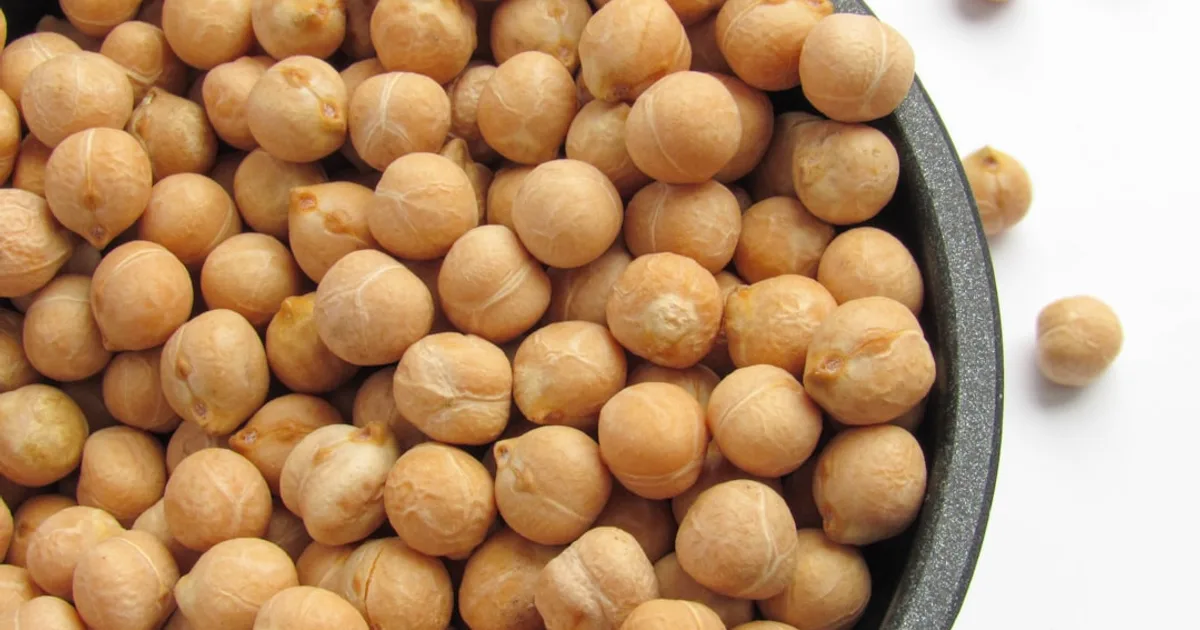
The honest case for growing chickpeas is not about competing with the dollar bag of dried garbanzos at the grocery store. That math doesn’t work in your favor. The case is about fresh green chickpeas - called ceci verde in Italian, hara chana in Hindi - which you can harvest at 60-70 days, eat raw or roasted like edamame, and almost never find at retail anywhere in the United States. And then there’s the hummus calculation, which turns modest dried-bean yield into something more interesting when you account for what processed product actually retails for.
Start there and chickpeas make sense. Start with dried-bean math alone and you might talk yourself out of it.
What It Actually Is
Cicer arietinum is a cool-season annual legume in the family Fabaceae, one of the oldest cultivated crops on earth - archaeobotanical evidence places it in cultivation in southeastern Turkey and the Fertile Crescent by approximately 7,500 BCE (Zohary, Hopf, and Weiss, Domestication of Plants in the Old World, 4th ed., Oxford University Press, 2012). It grows as a compact bush, 12-24 inches tall, with pinnately compound leaves covered in fine glandular hairs that secrete oxalic and malic acids. You can lick a leaf - it tastes faintly sour. That acidity deters a range of insect pests and is part of why chickpeas are among the lower-maintenance legumes to grow.
Two distinct market types exist, and which one you grow matters for how you plan to use the harvest.
Kabuli chickpea: large, round, smooth-coated seeds in cream or tan. This is the type in every can of garbanzo beans in the US, the standard hummus ingredient, and what most American seed catalogs sell. Milder flavor. Higher yield under most garden conditions. UC Davis Cooperative Extension variety trials (Natwick et al., 2009) document Kabuli yields of 1,500-2,000 lb per acre under irrigated California conditions - roughly 0.03-0.05 lb per square foot in a home garden setting.
Desi chickpea: smaller, angular seeds with dark coats ranging from speckled tan to deep brown-black. Higher fiber content, stronger and earthier flavor. Used in Indian cooking split into chana dal or ground into besan flour. Desi types tend toward lower garden yields than Kabuli but have more flavor complexity in fresh and dry preparations. If you’re growing for dal or besan rather than hummus, Desi is the right choice.
| Type | Seed size | Coat color | Flavor | Primary use |
|---|---|---|---|---|
| Kabuli | Large (8-9 mm) | Cream, tan | Mild, nutty | Canned, hummus, salads |
| Desi | Small (5-6 mm) | Brown, black, speckled | Earthy, stronger | Chana dal, besan flour, Indian cooking |
Most US gardeners default to Kabuli without knowing there’s a choice. Worth knowing before you order seed.
The ROI Case - Dried vs. Fresh
A $2.99 seed packet contains roughly 40-60 seeds. Direct-sown at 4-6 inch spacing in a 10-foot row, you get 20-30 plants. Per-plant dried yield in home garden conditions runs 0.1-0.15 lb of shelled dried chickpeas. A full 10-foot row at good spacing produces approximately 2-3 lb of dried chickpeas at maturity - call it 3 lb for a well-managed row, which aligns with the USDA ERS price data for retail dried chickpeas at $1.50-3.00/lb depending on organic vs. conventional and region.
The gross return on dried chickpeas from one packet:
| Scenario | Dried yield | Retail price/lb | Gross value | Seed cost | Net |
|---|---|---|---|---|---|
| Conservative | 2 lb | $1.50 | $3.00 | $2.99 | $0.01 |
| Mid | 3 lb | $2.00 | $6.00 | $2.99 | $3.01 |
| Optimistic | 3.5 lb | $3.00 | $10.50 | $2.99 | $7.51 |
The conservative case is essentially break-even. The mid case returns about $3 over seed cost. That’s not an argument for growing chickpeas if dried beans are your only goal.
Where the math changes: fresh green harvest. At 60-70 days, before pods dry down, chickpeas harvested green sell at $4-8/lb at specialty markets and Indian grocers where they appear at all - which is not often. In most US cities they’re hard to find. A 10-foot row harvested green at peak yields 1.5-2.5 lb of fresh pods, valued at $4-8/lb retail.
| Harvest mode | 10-ft row yield | Retail value/lb | Gross value | Seed cost | Net |
|---|---|---|---|---|---|
| Dried (100-110 days) | 2-3 lb | $1.50-3.00 | $3.00-9.00 | $2.99 | $0.01-6.01 |
| Fresh green (60-70 days) | 1.5-2.5 lb pods | $4.00-8.00 | $6.00-20.00 | $2.99 | $3.01-17.01 |
The fresh case is the more compelling one, on both value and availability grounds.
The Hummus Calculation
Here’s where the dried-bean math gets more interesting. You don’t have to sell or compare against dried chickpeas at commodity prices. You can compare against what processed chickpea products retail for.
One pound of dried chickpeas yields roughly 2.5 lb of cooked chickpeas after soaking and simmering. Standard hummus ratio is approximately 2 cups cooked chickpeas per batch, producing about 1.5 cups hummus. Scaled up: 1 lb dried chickpeas plus tahini ($0.25 cost), lemon ($0.10), garlic ($0.05), olive oil ($0.20), salt produces approximately 3 lb of hummus. Store-bought hummus runs $4-6/lb retail for standard brands - premium or organic brands run higher.
| Input | Cost |
|---|---|
| 1 lb dried chickpeas (home-grown, $2.99 packet / 3 lb yield) | $1.00 |
| Tahini, lemon, garlic, olive oil, salt | $0.60 |
| Total input cost | $1.60 |
| 3 lb hummus at $4/lb retail | $12.00 |
| 3 lb hummus at $6/lb retail | $18.00 |
| Net value (at $4/lb) | $10.40 |
| Net value (at $6/lb) | $16.40 |
The $0.90 in seed cost attributable to 1 lb of home-grown dried chickpeas (from a $2.99 packet yielding 3 lb) converts to $10-16 in hummus value. That’s the calculation worth making. The raw dried-bean comparison undersells the crop.
Homegrown dried chickpeas also have a practical advantage over store-bought: they’re fresh. Dried chickpeas that have been sitting in warehouse and grocery store storage for 6-18 months cook unevenly and take longer. Freshly dried homegrown chickpeas cook in 45-60 minutes after an overnight soak. The hummus texture is noticeably better - softer, creamier, without the chalky centers you sometimes get from old commercial dried beans.
Nitrogen Fixation and Bed Planning
Chickpeas fix atmospheric nitrogen via a symbiotic relationship with Mesorhizobium ciceri, a Rhizobium-family bacterium that colonizes root nodules. This is distinct from the bacteria that nodulate soybeans (Bradyrhizobium japonicum) or common beans (Rhizobium leguminosarum bv. phaseoli). A general legume inoculant may not carry the correct strain for chickpeas. Buy chickpea-specific inoculant (some suppliers label it “chickpea/lentil inoculant” - that combination works because both use Mesorhizobium strains). Per Purdue University Extension (Coulter and Sheaffer, “Inoculation of Legumes,” 2019), correct strain inoculation increases fixed nitrogen in chickpea by 40-60 lb per acre compared to uninoculated controls.
Inoculation process: moisten seed lightly, dust with inoculant powder, allow to dry in shade for 20-30 minutes before sowing. Don’t let inoculated seed sit in sunlight - UV kills the bacteria.
After chickpeas come out of the bed, you’re leaving behind root nodules containing roughly 50-80 lb/acre equivalent of fixed nitrogen in a well-managed planting (ATTRA - National Sustainable Agriculture Information Service, “Legumes: Cover Crops and Crops for Organic Systems,” 2020). In a 10-foot row, that’s modest but real. Rotate into a heavy nitrogen feeder the following year - leafy greens, corn, or brassicas - and you’ll see the benefit.
A 3-year rotation minimum is good practice for chickpeas regardless of nitrogen fixation, because of Ascochyta blight pressure (discussed below). The nitrogen-fixing benefit makes the rotation argument doubly compelling: you have both disease and fertility reasons to move them around the garden.
Season Length and Zone Suitability
This is where chickpeas get restrictive. One hundred to 110 days from transplant or direct sowing to dry harvest is a long ask. In Zone 5-6, last frost falls mid-April to mid-May. First fall frost comes late September to mid-October. You have roughly 150-165 frost-free days - enough for the full dry cycle, but without much margin. A cool, wet August will cause problems.
The crop also needs a hot, dry finish to mature seed properly. In humid climates - the Southeast, Gulf Coast, much of the Midwest in wet years - the drying-down phase coincides with late-summer humidity that promotes Botrytis (Botrytis cinerea) gray mold on pods and stems. This is the primary reason dried chickpea production in the US concentrates in the inland Pacific Northwest (Washington, Idaho) and parts of California - climates that deliver the hot, dry finish the crop needs.
For gardeners in the humid East and Midwest: consider harvesting green at 60-70 days as your primary strategy, and treating any dried harvest as a bonus if the summer cooperates. You avoid the Botrytis window entirely, you capture the higher-value fresh product, and you finish before the August humidity peaks. Zone 7+ with hot summers can reliably dry chickpeas; Zone 5-6 in humid climates should have a contingency plan for green harvest.
Growing Requirements
Soil temperature for germination: 60°F minimum, 65-75°F optimal. Below 55°F, germination rate drops sharply and seed may rot before germinating. Soil thermometer, not calendar date, is the right guide.
Direct sow depth: 1-2 inches. Space 4-6 inches apart in rows 18-24 inches apart. Closer spacing reduces airflow and invites fungal disease. Germination in 7-14 days at 65-70°F soil temperature.
Soil type: well-drained, moderate fertility. Sandy loam or loamy soil is ideal. Chickpeas fail in compacted, waterlogged soil. Heavy clay soils should be amended with compost and possibly raised for drainage. Preferred pH 6.0-7.0 (Summerfield et al., “Chickpea,” in Grain Legume Crops, Collins, 1985).
Fertilizer: none for nitrogen if properly inoculated. A balanced starter (5-10-10 or similar) at planting benefits phosphorus and potassium levels in poor soils. High-nitrogen fertilizer after inoculation suppresses nodule formation and defeats the fixation benefit - avoid it.
Water: 0.75-1 inch per week during germination and vegetative growth. Once established and flowering, reduce to 0.5-0.75 inches per week. Reduce further as pods fill and you target dried harvest. Overhead irrigation on chickpeas is asking for disease; drip irrigation or careful base watering is strongly preferred.
What Goes Wrong
Botrytis gray mold (Botrytis cinerea): fuzzy gray growth on stems, leaves, and pods in cool, humid, wet conditions. Prevention is primarily cultural - adequate plant spacing (don’t crowd), base watering only, morning irrigation if overhead is unavoidable so foliage dries during the day. Remove and bag infected material; don’t compost it. In a bad year in a humid climate, this can take out most of a planting in the drying-down phase.
Ascochyta blight (Ascochyta rabiei): the more serious disease threat. Brown-tan lesions with dark margins on leaves, stems, and pods; lesions on pods allow direct seed infection. It spreads rapidly in wet weather and can destroy an entire planting. The pathogen overwinters in infected crop debris and can persist in soil for 2-3 years. Control: buy certified pathogen-free seed from reputable suppliers (not farm-saved seed from an infected crop), practice 3-year rotation minimum, remove all crop debris after harvest. There are no effective fungicides labeled for home garden use against Ascochyta in chickpeas in most states.
Aphids: Acyrthosiphon pisum (pea aphid) and related species cluster on growing tips. The leaf acid secretions deter many pests, so aphid pressure on chickpeas tends to be lighter than on beans or peas. A strong water spray handles most infestations without intervention. Check under leaves on new growth.
Poor germination: almost always cold soil or old seed. Pre-soak seed 8 hours before sowing to speed germination in marginal conditions. Chickpea seed viability drops after 2-3 years in storage; buy fresh seed each season if germination was poor.
Harvest and Use
Fresh green harvest (ceci verde / hara chana): harvest at 60-70 days when pods are plump, bright green, and the beans inside feel firm under your fingers. The whole plant goes from flowering to full green pods over 2-3 weeks. Pick a few pods and pop them open - the beans should be bright green, tender, and slightly starchy. This is the window. Don’t wait for the plants to yellow; at that point you’re past fresh-use quality but not yet at dried quality and you’ve lost both options.
Young fresh pods (under 1 inch) can be eaten pod and all - they taste like a sweet snap pea. Larger green pods require shelling. Raw shelled green chickpeas are nutty and slightly grassy, like a fresh fava bean but milder. They can go raw into salads, be quickly sautéed in olive oil with garlic, or be roasted.
Roasting fresh (edamame-style): toss whole green pods in olive oil and coarse salt. Roast at 400°F for 12-15 minutes until the pods char at the edges and the beans inside are tender. Eat pod and all, squeezing the beans out. The flavor is nutty, slightly sweet, with a char edge that dried chickpeas never approximate. This is the preparation that converts people who otherwise find chickpeas unremarkable.
Dried harvest: let pods brown completely on the plant. The whole plant dies back; pods rattle when shaken. Harvest the whole plant, hang it in a dry, well-ventilated space for 1-2 additional weeks, then shell by hand or by putting pods in a bag and beating against a hard surface. Winnow the debris. Store dried chickpeas in airtight glass containers; they keep 2-3 years with no quality loss if kept dry and cool.
Hummus: soak dried chickpeas overnight (8-12 hours), drain, simmer in fresh water 45-75 minutes until very soft - a chickpea should crush easily between two fingers. Reserve the cooking water (aquafaba). Process 2 cups cooked chickpeas with 3 tablespoons tahini, 2 tablespoons lemon juice, 1 clove garlic, 3-4 tablespoons olive oil, 1/2 teaspoon salt, and 2-4 tablespoons cooking water until smooth. The aquafaba from home-cooked chickpeas also whips to stiff peaks as an egg white substitute - a use case canned chickpea liquid handles less reliably because the liquid is diluted.
Besan (chickpea flour): dried chickpeas ground fine in a high-powered blender or grain mill. Used in pakoras, socca, farinata, and as a gluten-free binding agent. Desi-type chickpeas produce the traditional besan flavor used in Indian cooking. Kabuli-type produces a milder flour better suited to European preparations like socca.
Related reading: Garden Pea - fellow cool-season legume with similar timing; Edamame - comparable fresh-bean harvest model; Peanut - fellow nitrogen-fixing legume; Fava Bean - large-seeded cool-season alternative; Adzuki Bean - Asian dry bean with similar growth habit; Tepary Bean - drought-tolerant alternative for hot-dry climates; Pigeon Pea - perennial legume for warm climates
Growing Chickpea? Track your harvest value and break-even date in the Garden ROI app.
Get the App